Tag Archives: hot money

by

If you thought the debt crisis in Europe was over, think again.

No comments yet

Categories: News Flash World Economy, Tags: , , , ,

Now the main stream media start again focusing on the eurozone with its hidden problems, as I wrote you earlier on my Blog.

———–

The nearly three-year old crisis appears to be entering a new phase as the respite in global financial markets, which came after the European Central Bank flooded the banking system with cash, has faded.

The focus has once again shifted to politics, long a source of agita for investors, with elections in several key nations set to change the balance of power in the eurozone.

As the economy slides toward recession, there is renewed debate over the wisdom of austerity, which Germany has made a priority, versus policies aimed at boosting growth.

This debate could decide the outcome of elections in France, Greece and now possibly the Netherlands. It could also determine the fate of Portugal, Spain and Italy, which are all struggling to regain credibility in the bond market.

“The emergence of these new coalitions will make crisis management more acrimonious,” wrote Eurasia Group analysts in a note.

Europe: ‘Dark clouds on the horizon’

While policy makers have taken steps to contain the crisis, many of the longer term problems have yet to be resolved.

Meanwhile, the uncertain political and economic outlook is making investors nervous, putting pressure on the ECB to do even more to stabilize the financial markets.

Here are a few things to keep an eye on in the weeks ahead.

Merkozy’s days are numbered

In France, socialist candidate Francois Hollande narrowly defeated incumbent Nicolas Sarkozy in the first round of the nation’s presidential elections last weekend.

Hollande is favored to win the final round of voting on May 6, although the race could be tighter than expected.

France and Germany have been the main players in the response to the crisis to date, so much so that Sarkozy and German Chancellor Angela Merkel have become known as “Merkozy.”

The Merkozy doctrine, such as it is, has been to demand austerity measures from eurozone nations that have requested bailouts from the EU and International Monetary Fund.

The two leaders have also been pushing for more political and economic “integration” as the main proponents of the “fiscal compact” that euro area leaders signed late last year.
5 things to know about the French election – CNN

Hollande, however, has suggested that he would renegotiate the fiscal compact before recommending that France ratify the proposed budget rules and penalties.

He has also called for more growth-oriented policies, suggesting that Hollande could have a complicated relationship with Merkel, who favors spending cuts.

Budget fight breaks Netherlands government

Meanwhile, the Netherlands has emerged as another source of political uncertainty after an impasse over budget cuts caused the nation’s prime minister to resign.

Prime Minister Mark Rutte resigned after far-right party leader Geert Wilders withdrew his support for cuts needed to meet EU budget rules.

It was not immediately clear what will happen next, but Wilders and other Dutch politicians have reportedly called for elections as soon as possible.

The political turmoil raised worries that the Netherlands, one of the few AAA-rated eurozone nations, could have its credit rating downgraded.

Greece is still in bad shape

Amid a shrinking economy and deepening austerity, Greek voters are scheduled to elect a new government on May 6.

Greece has been run by a caretaker government since Prime Minister George Papandreou resigned late last year, under pressure from France and Germany.

Lucas Papademos, the interim prime minister, orchestrated the largest sovereign debt default in history and secured a second €130 billion bailout program during his six months in office.

To qualify for the bailout, Greece was required to enact a raft of austerity measures and agree to a program of structural reforms that will be overseen by the IMF for the next few years.

Greece has already endured years of austerity, which many economists say has worsened the nation’s recession. In addition, Greece’s debt load will still be very high and may require further restructuring even if it completes the reforms under its bailout program.

This suggests that Greece will either be forced out or will decide to abandon the euro currency union later this year, according to Capital Economics.

Domino effect: Portugal, Spain and Italy

After Greece, investors see Portugal as the most likely candidate for another bailout.

Portugal’s borrowing costs shot higher earlier this year amid fears the nation could seek to restructure its debts. Investors were also rattled after Standard & Poor’s downgraded Lisbon’s credit rating to junk in January.

In its most recent review, the IMF said that Portugal was “broadly on track” with the €78 billion bailout program the nation tapped nearly a year ago.

While the Portuguese economy is comparatively small, the nation’s woes have highlighted the challenges facing larger eurozone economies, such as Spain and Italy.

Spain recently disclosed that its 2011 budget deficit was much larger than expected and warned that the government may not meet its fiscal targets for 2012.

Prime Minister Mariano Rajoy, in power since December, has proposed a €27 billion austerity program. But the Spanish economy, which is suffering from high unemployment and problems in the banking sector tied to the real estate market, has slipped back into recession.

While the authorities say Spain can avoid a bailout, yields on Spanish bonds have risen sharply recently as investors fear the nation will require some sort of external support.

Investors are also worried about Italy, the eurozone’s third-largest economy, despite progress made by Prime Minister Mario Monti on labor and other market reforms.

The concern is that if Spain needs to be bailed out, there will not be enough money left over to support Italy in the event that Monti’s reforms fall short.

Monti, who was appointed after Silvio Berlusconi stepped down late last year, has also been pushing back against austerity and emphasizing the need to stimulate growth as Italy’s economy has stagnated for years.

ECB’s options are limited

The ECB stepped up its efforts to prevent a credit crisis late last year when it offered European banks unlimited access to cheap, long-term loans.

In two separate operations, the ECB pumped over €1 trillion into the banking system.

ECB president Mario Draghi has said the goal was to help banks struggling to fund themselves amid concerns about exposure to sovereign debt. But the flood of liquidity also appeared to help drive down borrowing costs for troubled eurozone governments.

As yields move back into the danger zone, investors are again looking to the ECB to save the day.
Investors to ECB: 1 trillion euros is not enough

There is speculation that the ECB could resume limited purchases of government debt under its controversial securities market program.

Some analysts have also suggested that the ECB could move to full-blown quantitative easing, a strategy used by the Federal Reserve, to help boost the economy.

However, such steps would violate the ECB’s mandate, which is to maintain price stability, and the bank has already stepped way out of its comfort zone. In addition, intervening in the bond market raises thorny questions of “moral hazard.”

Instead, Draghi has stressed that governments must push ahead with fiscal consolidation and reforms to increase economic competitiveness.

Compiled source from: Ben Rooney – CNNmoney

by

All Central Bank Balance Sheets Are Exploding Higher!

No comments yet

Categories: News Flash - Market today, Tags: , , ,

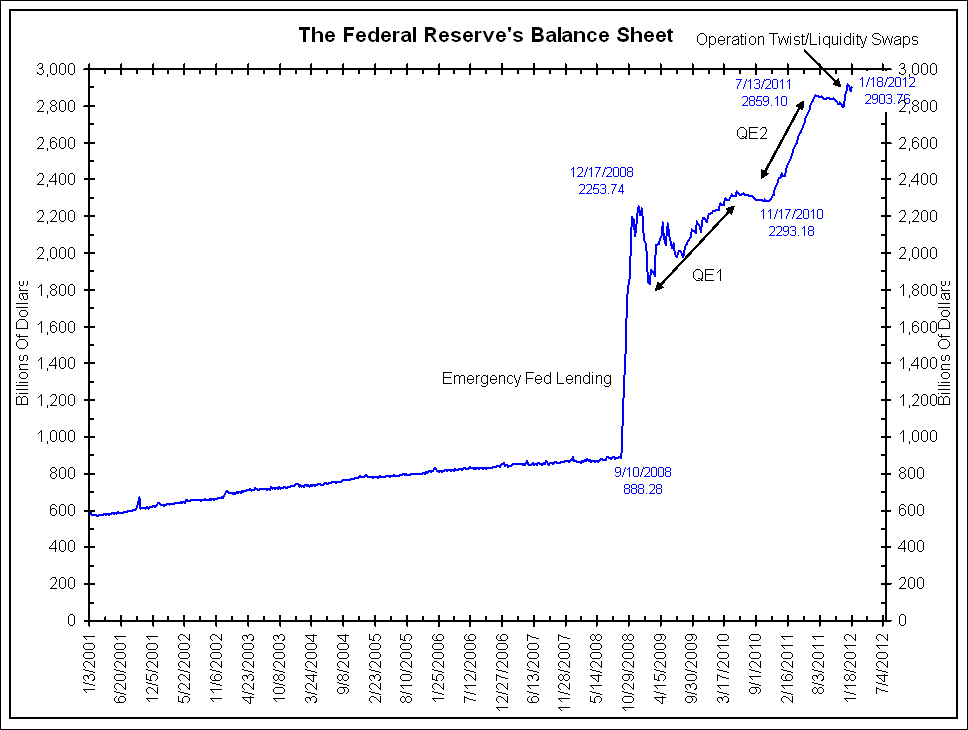
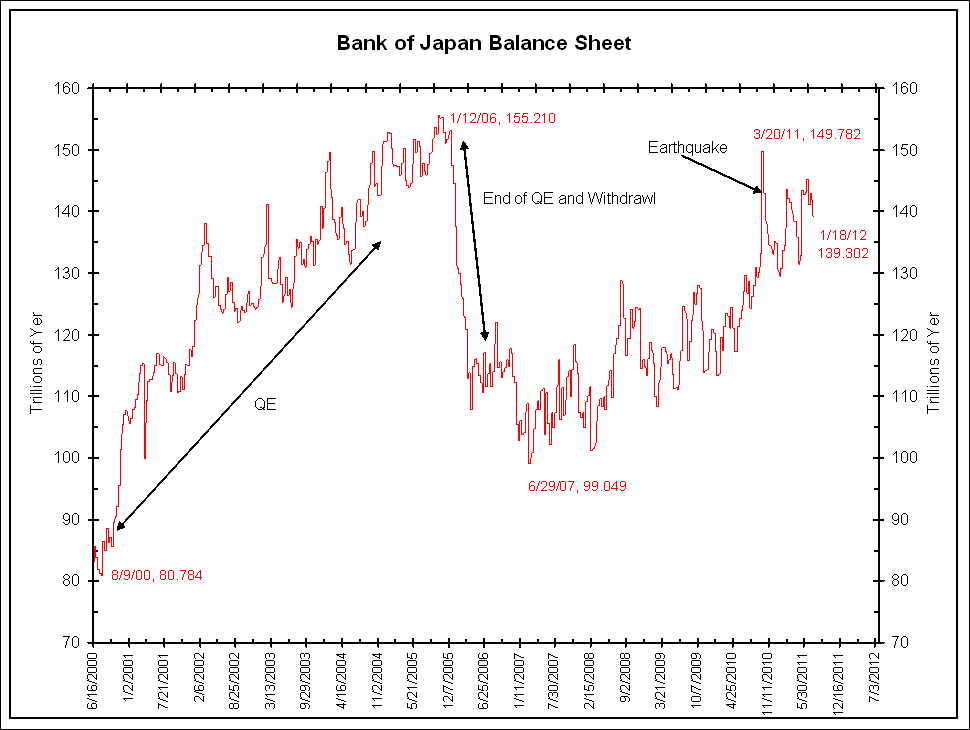
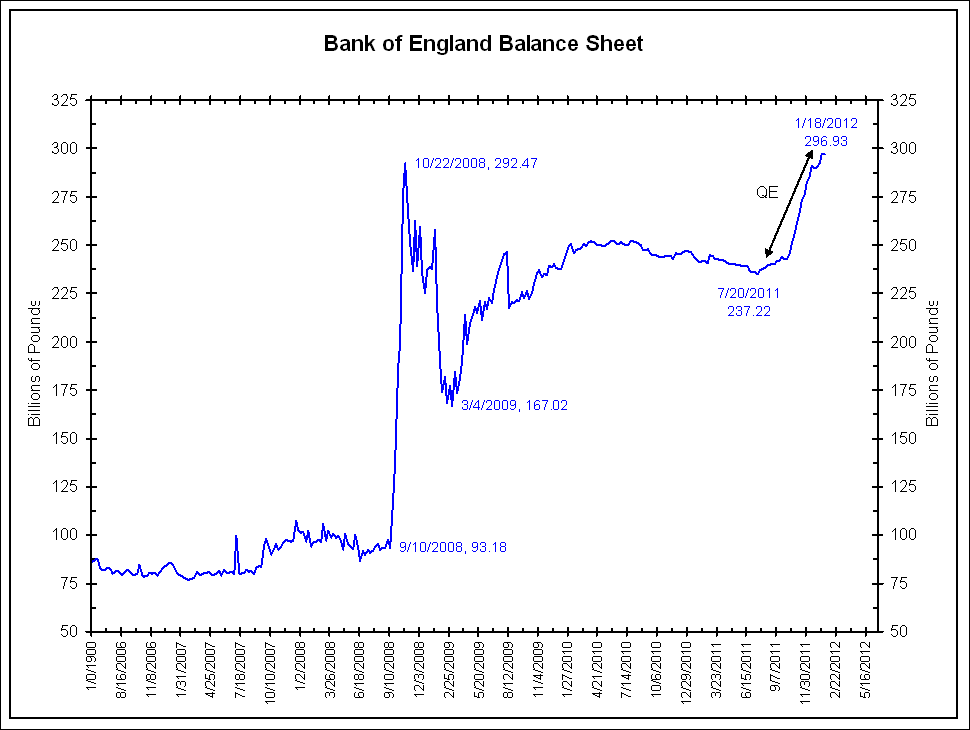
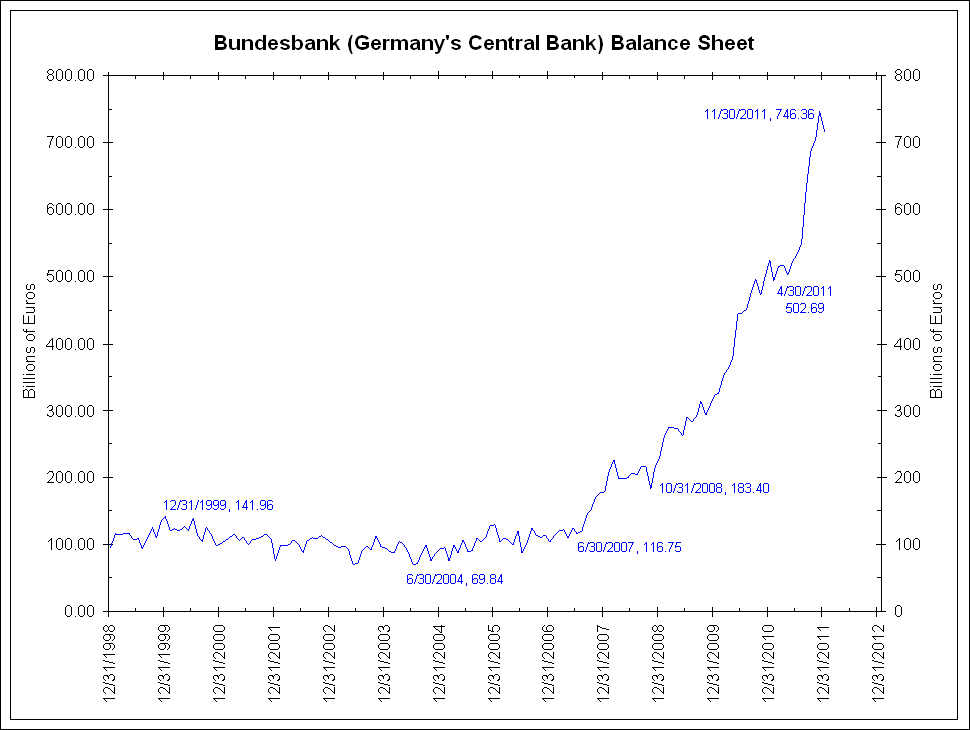
All Central Bank Balance Sheets Are Exploding Higher, Or Engaged In QE

The degree to which central banks around the world are printing money is unprecedented.

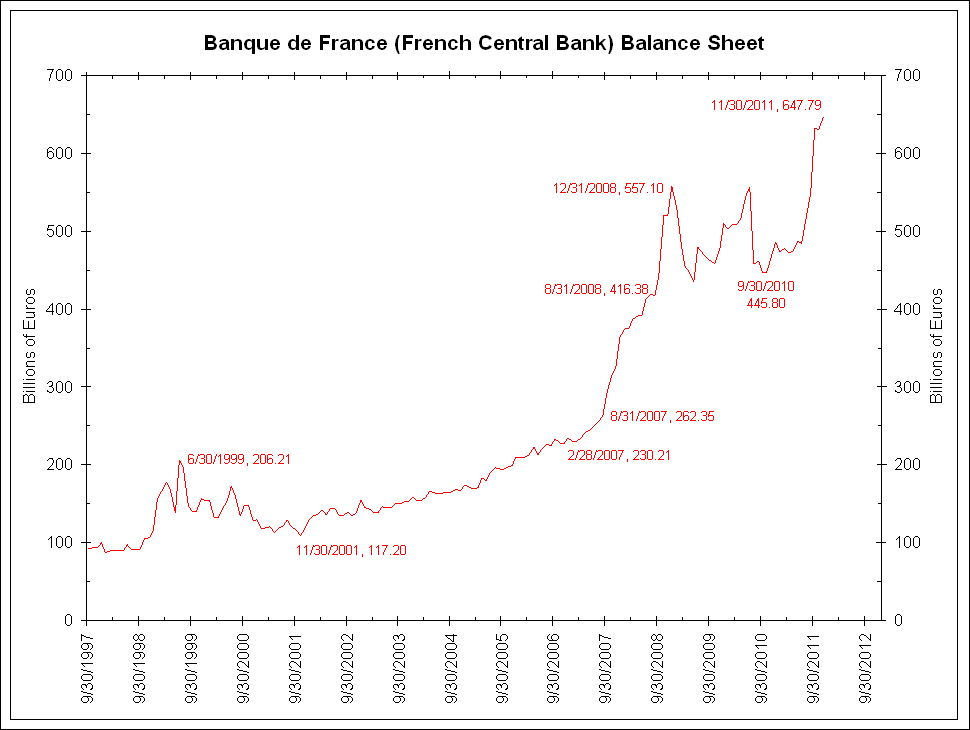
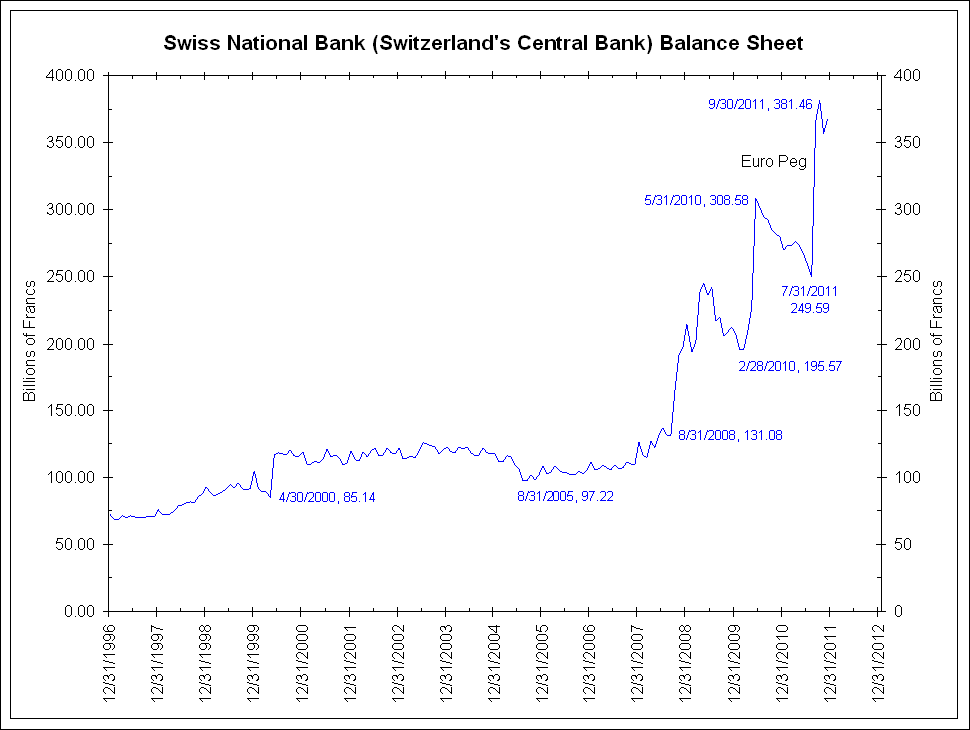
The first eight charts below show the balance sheets of the largest central banks in the world. They are the European Central Bank (ECB), the Federal Reserve (Fed), the Bank of Japan (BoJ), the Bank of England (BoE), the Bundesbank (Germany), the Banque de France, the People’s Bank of China (PBoC) and the Swiss National Bank (SNB).  Noted on the charts are significant events or growth rates.

Shown is the size of each respective balance sheet in its local currency.  Note that all are exploding higher as every chart goes from the lower left to the upper right.  Most are still making new all-time highs. If the basic definition of quantitative easing (QE) is a significant increase in a central bank’s balance sheet via increasing banking reserves, then all eight of these central banks are engaged in QE.


Click to enlarge:

˜˜˜


Comparing Central Bank Balance Sheets

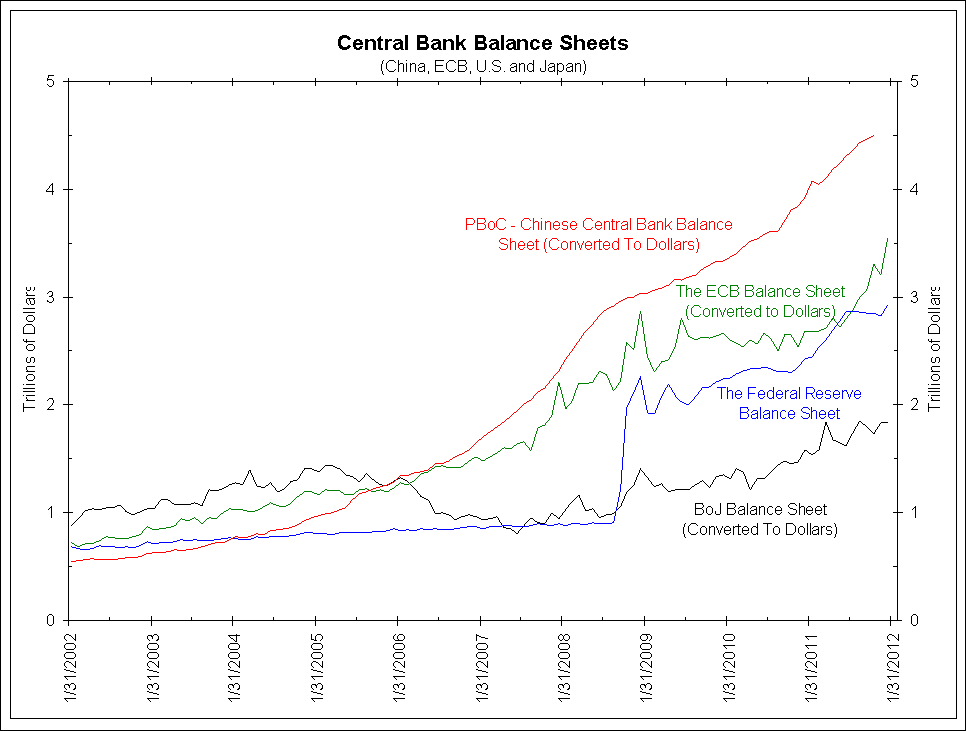
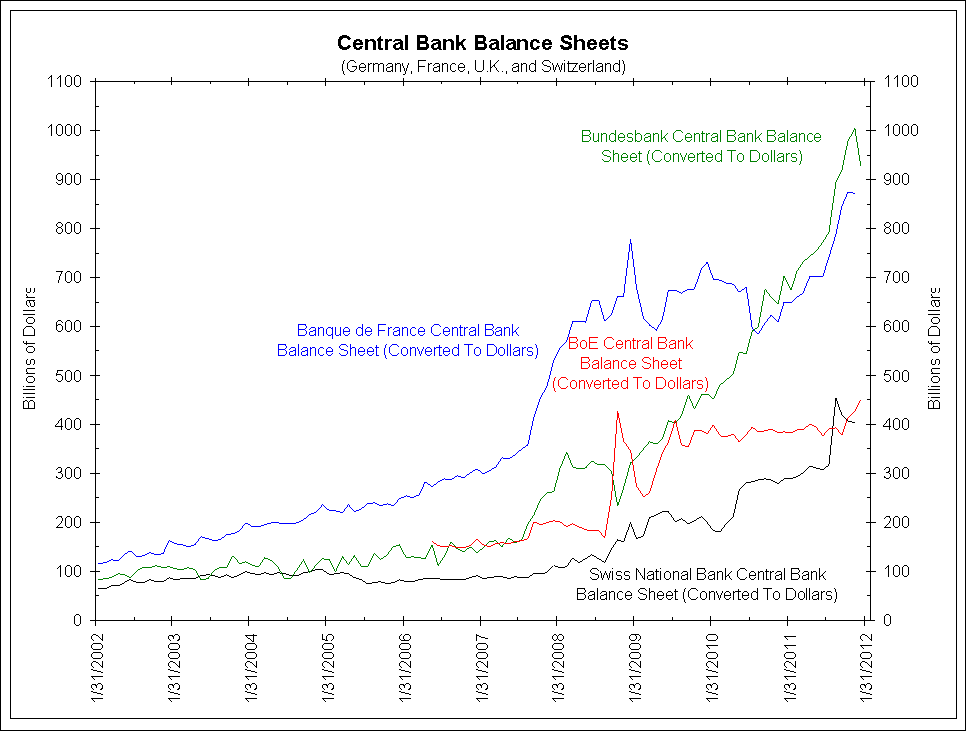
For comparison’s sake, we converted the eight balance sheets above into dollar terms.  The four largest, the PBoC, the Fed, the BoJ and the ECB are shown in the first chart below.  The second four, the Bundesbank, Banque de France, the BoE and SNB are shown in the second chart below.   We split them up because of their vastly different scales.

In the first chart, note that the balance sheets of the PBoC and the ECB are larger than the Federal Reserve when converted to dollars.  The BoJ used to be the largest balance sheet in dollar terms until 2006.

When shown in dollar terms below, the Bundesbank is the largest of the “second four” central banks.  Further, its growth rate over the last five years has been among the highest.  This is surprising since the Bundesbank is considered the “hard money” central bank.

Combining Central Bank Balance Sheets

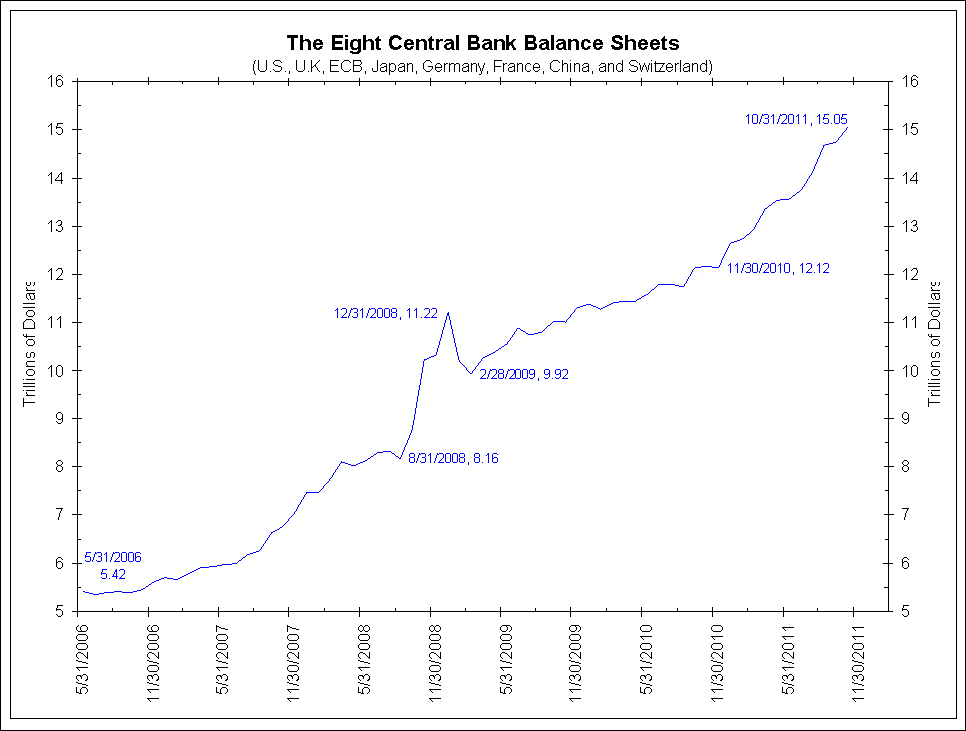
The next chart below adds up the eight largest central bank balance sheets in dollar terms.  It is only current through October as that is the latest number from the PBoC.

The combined size of these eight central banks’ balance sheets has almost tripled in the last six years from $5.42 trillion to more than $15 trillion and is still on the rise!

Central Banks Equal To One-Third Of World Equity Values

As noted above, QE is an expanding of balance sheets via increasing bank reserves.  The purpose of QE, as explained by this Bank of England video,  is to increase bank reserves through purchases of fixed income securities in order to lower interest rates.  This makes fixed income securities relatively unattractive/overvalued and pushes investors out the risk curve.  This should increase buying for riskier assets such as stocks, pushing them higher in price.  Theoretically these higher prices should lead to a wealth effect and increased economic activity.

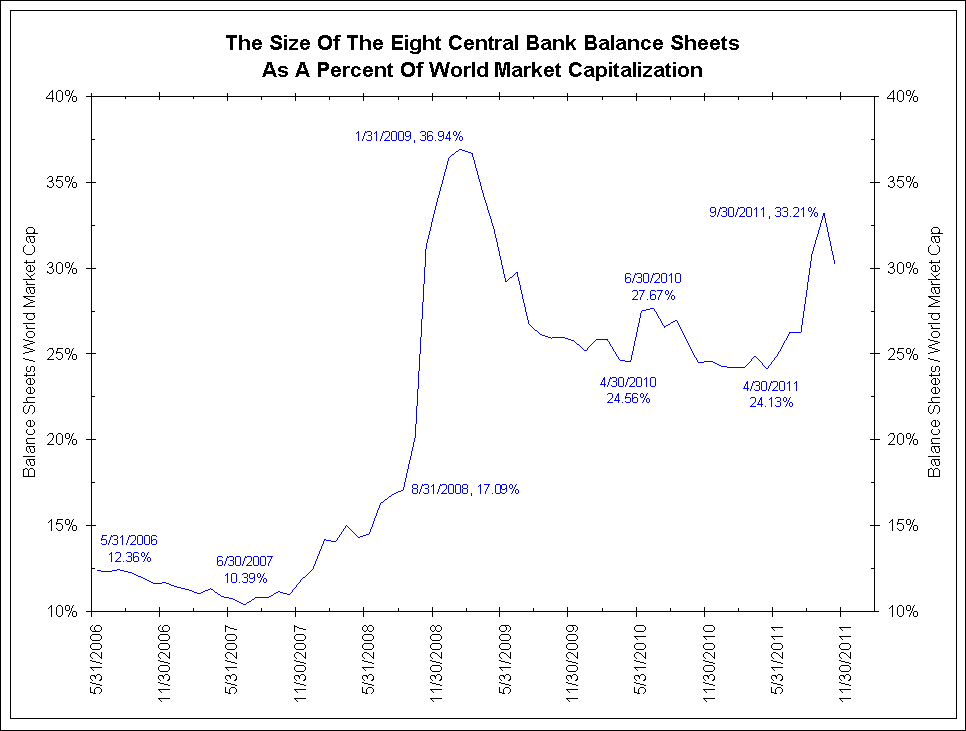
Given this definition and purpose, it is fair to compare the size of these balance sheets (now $15 trillion) to the capitalization of the world’s stock markets (now $48 trillion).  This is shown in the chart below.

Prior to the 2008 financial crisis, the eight central bank balance sheets were less than 15% the size of world stock markets and falling.  In the immediate aftermath of Lehman Brothers’ failure, these eight central bank balance sheets swelled to 37% the capitalization of the world stock market.  But keep in mind that the late 2008/early 2009 peak was due to collapsing stock market values combined with balance sheet expansion via “lender of last resort” loans.

Recently, the eight central bank balance sheets have spiked back to 33% of world stock market capitalization.  This has come about not by lender of last resort loans, but rather by QE expansion (buying bonds with printed money) even faster than world stock markets are rising.

What Does It All Mean?

2011 was so difficult because all stocks seemingly moved together.  It was as if every S&P 500 company had the same chairman of the board that knew only one strategy, resulting in a high degree of correlation between seemingly unrelated companies.

Massive central bank involvement in the markets risks returning us to a de facto centrally planned economy. Those S&P 500 companies all have the same chairman; it is Ben Bernanke because his policies are affecting everybody. That is what makes money management so difficult. Correlations will ebb and flow; they always do. But what makes them go away? This will only happen when governments and central banks go away.

But if they go away, then does that not mean things get ugly? Maybe they do get ugly, but it also means that we sort out the excesses in the market. We reward the people that do the right thing and we punish the people that do the wrong thing. And we have an adjustment process that may be ugly, but then we have a period of long expansion.

Central banks are ruling markets to a degree this generation has not seen.  Collectively they are printing money to a degree never seen in human history.

So how does this process get reversed?  How do central banks pull back trillions of dollars of money printing without throwing markets into a tailspin?  Frankly, no one knows, least of all central banks as they continue to make new money printing records.

Until a worldwide exit strategy can be articulated and understood, risk markets will rise and fall based on the perceptions and realities of central bank balance sheets.  As long as this is perceived to be a good thing, like perpetually rising home prices were perceived to be a good thing, risk markets will rise.

When/If these central banks go too far, as was eventually the case with home prices, expanding balance sheets will no longer be looked upon in a positive light.  Instead they will be viewed in the same light as CDOs backed by sub-prime mortgages were when home prices were falling.  The heads of these central banks will no longer be put on a pedestal but looked upon as eight Alan Greenspans that caused a financial crisis.

The tipping point between balance sheet expansion being bullish for risk assets versus bearish is impossible to know.  Given the growth rate of central bank balance sheets around the world over the past few years, we might not have to wait too long to find out.  Enjoy it while it is still bullish.

Future will show where the giant ship is heading, stay tuned and trade safe.

Erik

Source: Bianco Research


by

The Japanese – China similarity Is the (hot) money already running out from China ?

No comments yet

Categories: News Flash World Economy, Tags: , , ,

“If you do not change direction, you may end up where you are heading.” — Lao Tzu


Most everyone thinks they know where China is headed — that is, toward world domination thanks to having the most-vibrant large economy in the world.

Of course, whenever we project from the recent past, we usually end up disappointed. And for many, their expectations for China will be no exception.

There are many obstacles along the way before China rules the economic world, and one of them is what we have dubbed “The Japanese Parallel.” This would be a game-changer, one with major implications for all global asset markets, especially currencies.

The credit crunch that happened circa 2008 took a big bite out of the U.S. consumer and has drained a lot of dollar credit out of the global system. In the aftermath, the Chinese government stepped up in a big way — replacing U.S. consumer demand with direct stimulus, to the tune of approximately half the size of the country’s GDP, in an effort to keep the music playing.

The song should be a familiar one because, interestingly, we saw a similar scenario play out before in the global economy. China’s future is on a seemingly eerie parallel with Japan’s global macroeconomic history.

The Parallel in Play

During the 1980s, it appeared Japan — as the “Creditor Superpower” — was going to gobble up the world with its powerful export machine and massive current account surpluses rolling in.

Then a little thing called the U.S. stock market crash in 1987 changed the game.

Dollar credit flowed from the global system, triggering an improvement in the U.S. current account balance (see the top-left gold box in the chart below) that was followed by a U.S. recession. This came as the Japanese yen was appreciating in value, thanks to the G-7 Plaza Accord to pressure the yen higher because of all those Japanese exports.

Black Swan Capital
Source: Black Swan Capital

Here’s a brief history on what happened to Japan:

  1. Japan’s very hot stock market broke in 1989.
  2. Then its extremely overpriced real-estate bubble started its collapse. (Remember when the Imperial Palace in Tokyo was worth more than the entire state of California?)
  3. Japanese authorities did all they could in the form of stimulus to try to keep air in the bubble. They …
    1. Pumped more money into the stock and property markets in order to revive the wealth effect for domestic consumers.
    2. Subsidized export companies to keep exports flowing (but the world’s major consumer — the U.S. economy — was entering recession and therefore wasn’t there to buy).
    3. Lowered interest rates to zero.
    4. Continued massive fiscal stimulus by building infrastructure across the country.

But, it didn’t work.

The massive dislocations were caused by the artificial channeling of credit within the Japanese economy in order to focus almost entirely on building a global export machine.

In turn, these dislocations created the malinvestment that has taken years to work off, precisely because the Japanese economy was so imbalanced when it came to production versus consumption.

Attempts to change this model were scant at best; instead, they kept morbid companies alive and forced consumers to save money, thanks to artificially low interest rates.

7 Reasons Why the China Story
Might Not Have a Happy Ending

Fast-forward to China today … and you can witness the parallels …

Instead of the U.S. stock market crash being the triggering event, we have the credit crunch in its place — arguably a much-bigger and more-powerful global event.

Secondly, global leverage — i.e., debt in the system — was massively larger in 2007 than it was in 1987. (In other words, the world was hooked on massive dollar-based credit spewed out by the trillions of dollars in derivatives production.)

Mr. U.S. consumer has pulled in his horns much more quickly and to a greater degree than he did back in 1987. This takes much more global demand for goods out of the market — demand that China was and still is so highly addicted to.

And interestingly, now we also have the Chinese currency starting to rise in value, albeit at a much-slower pace than the Japanese yen did in the 1980s.

So what has China done to overcome this sea change in the global economy that’s evidenced by the improvement in the U.S. current account? The country has done many of the same things Japan has done, and we are seeing a replay of events to a degree.

Here’s where those parallels really come into play:

1) China’s very hot stock market topped out in October 2007 and is now 59 percent off its old high. (That is a major drag on the so-called “wealth effect.”) The Chinese government owns or controls most of the stocks on its exchange and, yet, it has been unable to keep them pumped up.

2) China’s real estate prices have started falling and the “bubbly conditions” are becoming quite apparent to all. But now, with tightening credit in China, the bubble is in jeopardy. As a recent Financial Times article reported:

“The number of property transactions in China’s largest cities has fallen to dangerously low levels, according to regulatory documents obtained by the Financial Times.

“According to the documents, the China Banking Regulatory Commission earlier this year ordered domestic banks to weigh the impact of a 30% decline in housing transactions in ‘stress tests’ aimed at determining the health of the Chinese financial system.”

3) China’s real estate market, especially on the commercial side, is extremely overbuilt. A massive amount of speculative credit has poured in that could come rushing out; already there are signs that the hot money is running from China.

Interesting point here: Despite Western pressure on China’s currency policy, country leaders have made it clear there will not be any type of one-time ramp-up revaluations; this adds to the momentum of hot money (that had poured into China) to leave.

Part of that hot money was specifically positioned in real assets to benefit from such a large one-off revaluation.

4) The country pumped more money into the stock and property markets in order to revive the wealth effect for domestic consumers. It hasn’t worked, just as it didn’t in Japan.

And just as Japan found out, there is no fallback to local demand if international demand disappears for their exports. This is already in play.

5) They subsidized export companies to keep exports flowing. (But the world’s major consumer is taking the goods to the degree that it did before the credit crunch.)

China has managed to push some of the pain of domestic adjustment off its trade partners thus far. But if the U.S. consumer does not materialize, trade frictions will grow for China — not just in the West, but also from its Asian-bloc competitors. This is already in play as well.

6) China’s interest rates are not at zero, but they are extremely low for a country supposedly growing as fast as it has. This low interest rate policy is similar to what Japan did. This leads to forced savings and smothers local consumer demand at a time when domestic consumption is most needed.

7) They continued massive fiscal stimulus by building infrastructure across the country. China’s infrastructure development is legendary. It has led to extreme overcapacity across many sectors.

If global demand is not there to take the final goods all this capacity can produce, then much of that capital will be wasted (i.e., malinvestment). This is what happens when a government determines investment policy instead of letting the market do its job.

Officially, China sports quite a low debt-to-GDP ratio. But if you consider that Chinese banks are effectively government conduits, some have estimated debt-to-GDP in China is somewhere between 70 percent and 80 percent.

Could China Get Hit
Harder Than Japan?

The credit crunch is the market’s way of starting to rebalance a very imbalanced global world that has at the heart of it:

  • A flawed world reserve currency system;
  • Inordinate demand and depth of capital markets concentrated in one place (i.e., the United States); and
  • A beggar-thy-neighbor — by which the country attempts to help itself by using measures that negatively impact other countries — export policy (Asia), leading to massively suppressed relative currency values.

This potential global macro replay shows that policymakers have either learned little, or are unwilling to do the heavy lifting, when it comes to real global monetary reform.

If the Chinese economy plays out like Japan’s did when its credit bubble burst, the implications for the global economy would be dire, as we are still in the midst of massive private deleveraging. This is already overwhelming the public debt being poured into the system, and it has created the nasty byproduct of shaky sovereign credits across all Western nations.

So, we continue to watch as China ticks off the historical markets that crushed Japan’s growth and economic leadership. And we hope that the part about history repeating in another form is wrong. Otherwise, it could be even uglier this time around.

Good trading

Erik

Ps. Source: Jack Cook – Senior Currency investor and market analyst