Site Moderator

by

All Central Bank Balance Sheets Are Exploding Higher!

No comments yet

Categories: News Flash - Market today, Tags: , , ,

All Central Bank Balance Sheets Are Exploding Higher, Or Engaged In QE

The degree to which central banks around the world are printing money is unprecedented.

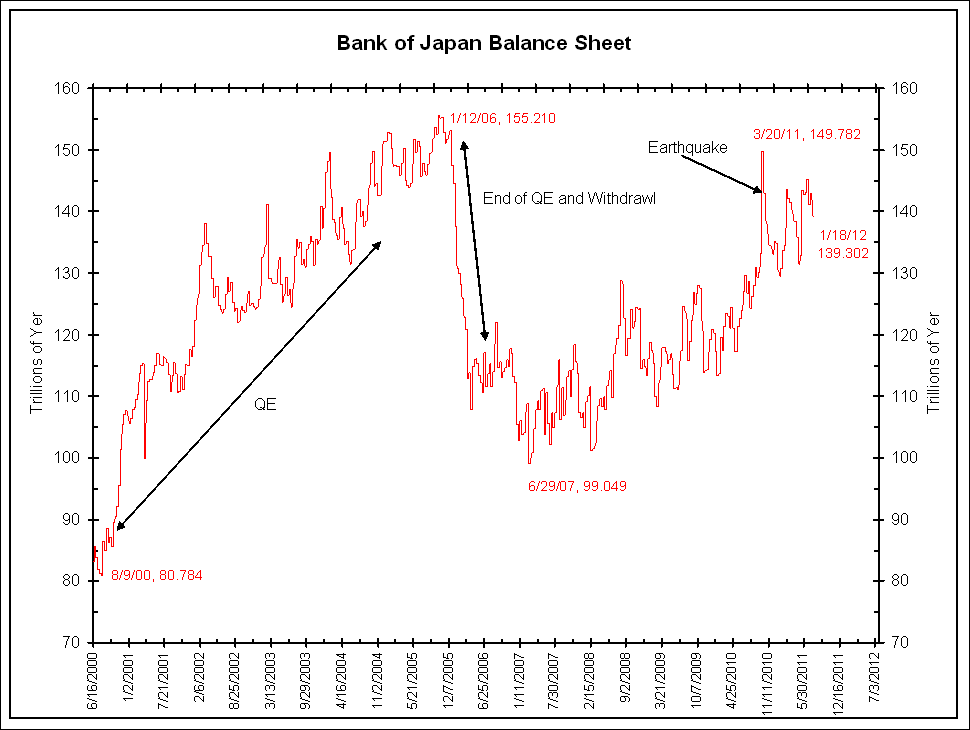
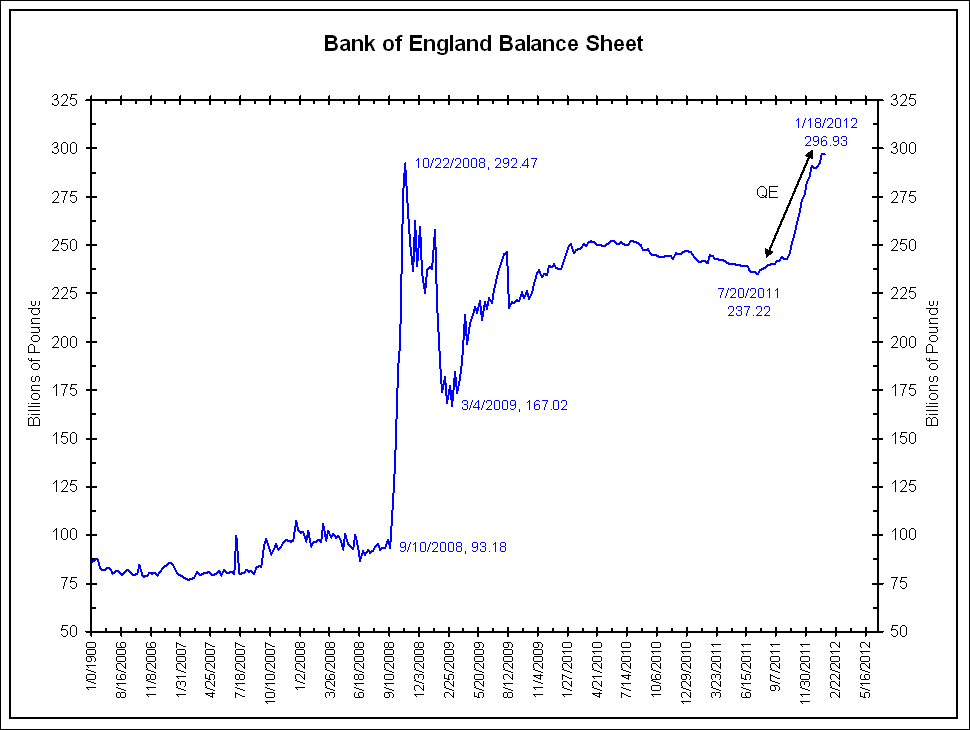
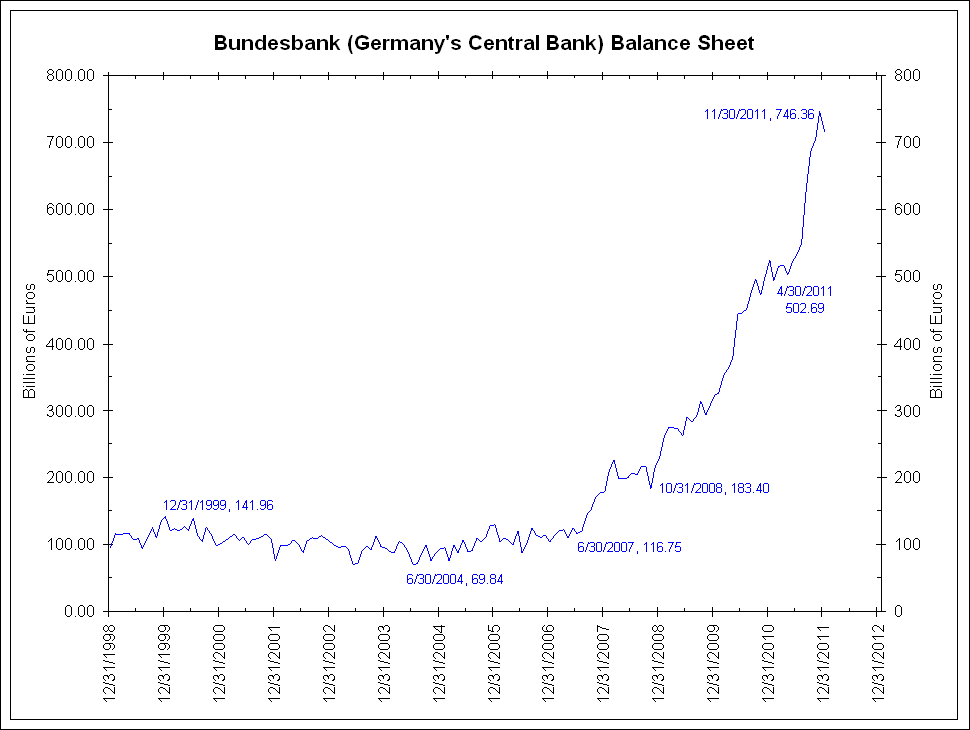
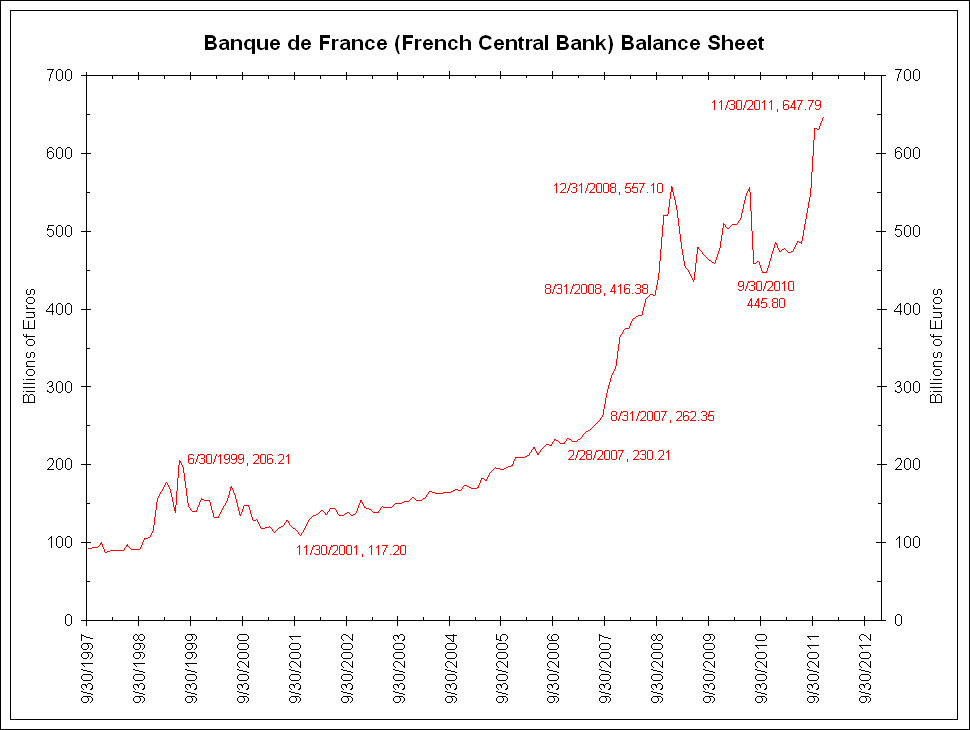
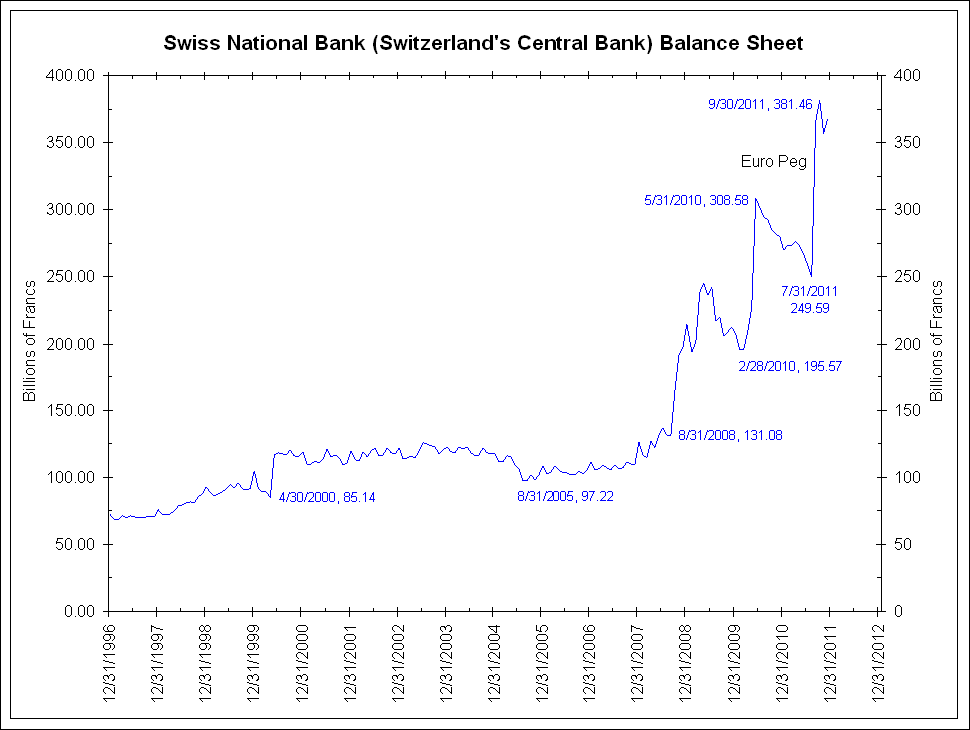
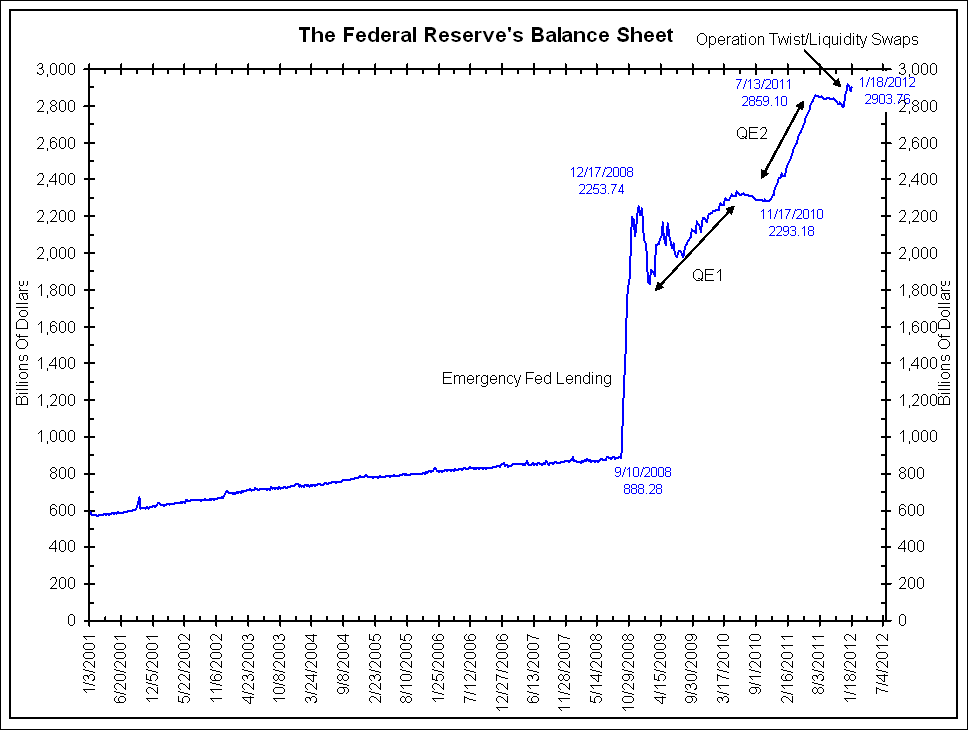
The first eight charts below show the balance sheets of the largest central banks in the world. They are the European Central Bank (ECB), the Federal Reserve (Fed), the Bank of Japan (BoJ), the Bank of England (BoE), the Bundesbank (Germany), the Banque de France, the People’s Bank of China (PBoC) and the Swiss National Bank (SNB).  Noted on the charts are significant events or growth rates.

Shown is the size of each respective balance sheet in its local currency.  Note that all are exploding higher as every chart goes from the lower left to the upper right.  Most are still making new all-time highs. If the basic definition of quantitative easing (QE) is a significant increase in a central bank’s balance sheet via increasing banking reserves, then all eight of these central banks are engaged in QE.


Click to enlarge:

˜˜˜


Comparing Central Bank Balance Sheets

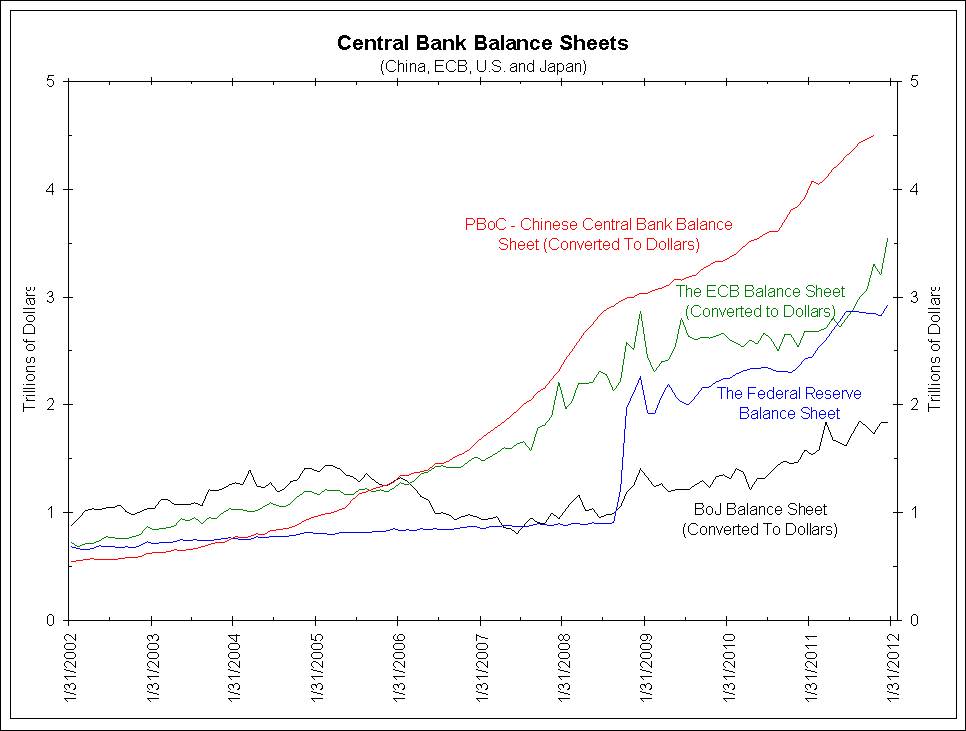
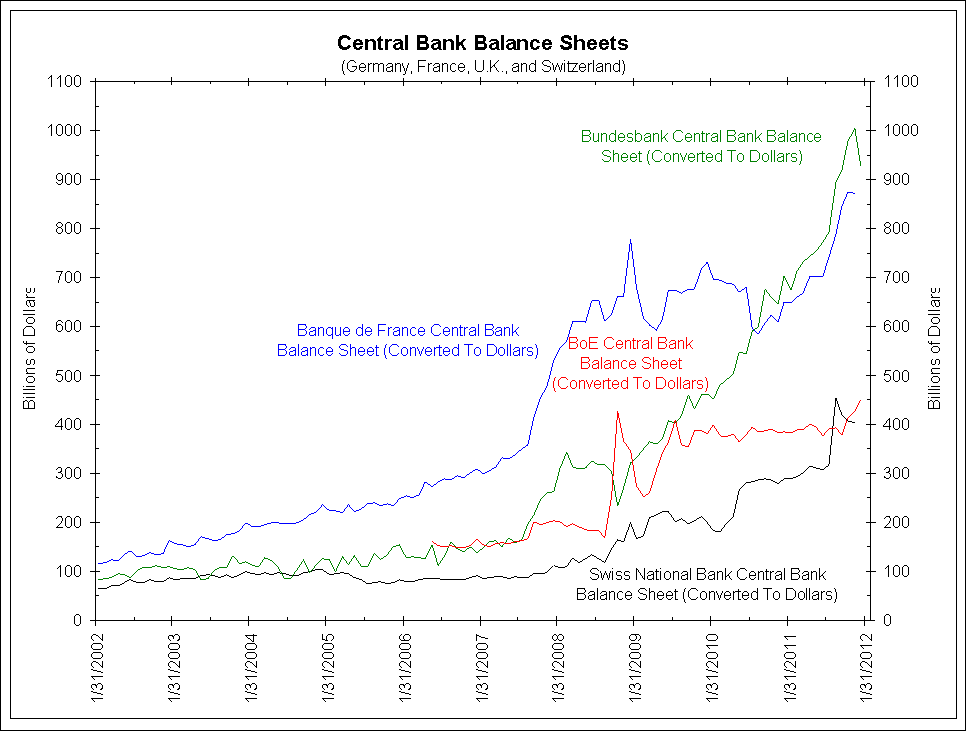
For comparison’s sake, we converted the eight balance sheets above into dollar terms.  The four largest, the PBoC, the Fed, the BoJ and the ECB are shown in the first chart below.  The second four, the Bundesbank, Banque de France, the BoE and SNB are shown in the second chart below.   We split them up because of their vastly different scales.

In the first chart, note that the balance sheets of the PBoC and the ECB are larger than the Federal Reserve when converted to dollars.  The BoJ used to be the largest balance sheet in dollar terms until 2006.
When shown in dollar terms below, the Bundesbank is the largest of the “second four” central banks.  Further, its growth rate over the last five years has been among the highest.  This is surprising since the Bundesbank is considered the “hard money” central bank.
Combining Central Bank Balance Sheets

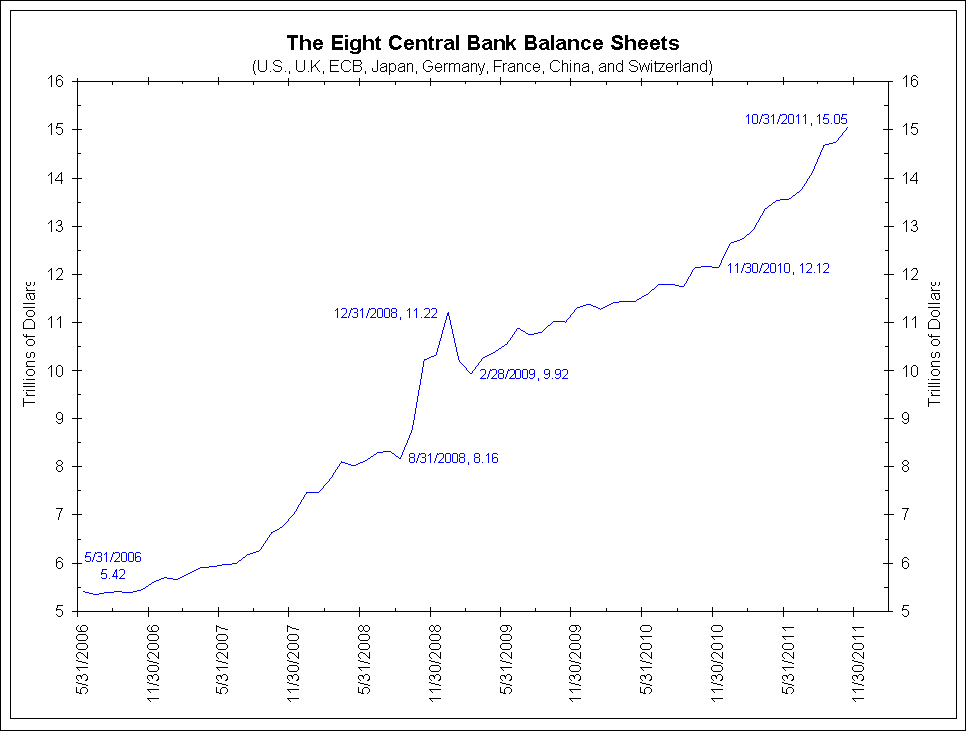
The next chart below adds up the eight largest central bank balance sheets in dollar terms.  It is only current through October as that is the latest number from the PBoC.

The combined size of these eight central banks’ balance sheets has almost tripled in the last six years from $5.42 trillion to more than $15 trillion and is still on the rise!
Central Banks Equal To One-Third Of World Equity Values

As noted above, QE is an expanding of balance sheets via increasing bank reserves.  The purpose of QE, as explained by this Bank of England video,  is to increase bank reserves through purchases of fixed income securities in order to lower interest rates.  This makes fixed income securities relatively unattractive/overvalued and pushes investors out the risk curve.  This should increase buying for riskier assets such as stocks, pushing them higher in price.  Theoretically these higher prices should lead to a wealth effect and increased economic activity.

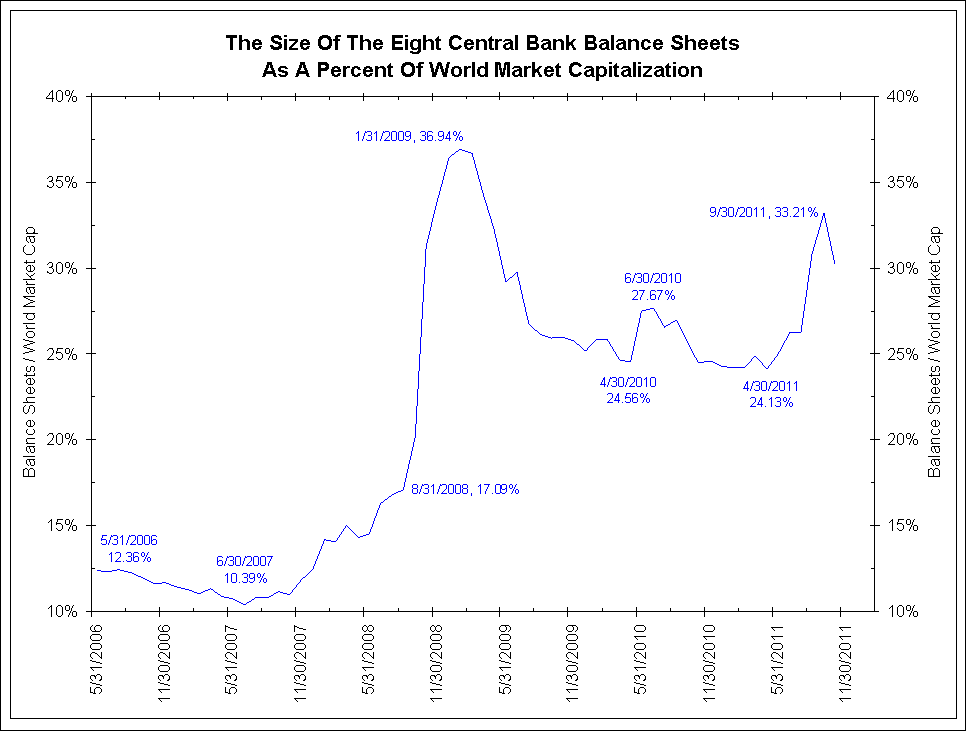
Given this definition and purpose, it is fair to compare the size of these balance sheets (now $15 trillion) to the capitalization of the world’s stock markets (now $48 trillion).  This is shown in the chart below.

Prior to the 2008 financial crisis, the eight central bank balance sheets were less than 15% the size of world stock markets and falling.  In the immediate aftermath of Lehman Brothers’ failure, these eight central bank balance sheets swelled to 37% the capitalization of the world stock market.  But keep in mind that the late 2008/early 2009 peak was due to collapsing stock market values combined with balance sheet expansion via “lender of last resort” loans.

Recently, the eight central bank balance sheets have spiked back to 33% of world stock market capitalization.  This has come about not by lender of last resort loans, but rather by QE expansion (buying bonds with printed money) even faster than world stock markets are rising.
What Does It All Mean?

2011 was so difficult because all stocks seemingly moved together.  It was as if every S&P 500 company had the same chairman of the board that knew only one strategy, resulting in a high degree of correlation between seemingly unrelated companies.

Massive central bank involvement in the markets risks returning us to a de facto centrally planned economy. Those S&P 500 companies all have the same chairman; it is Ben Bernanke because his policies are affecting everybody. That is what makes money management so difficult. Correlations will ebb and flow; they always do. But what makes them go away? This will only happen when governments and central banks go away.

But if they go away, then does that not mean things get ugly? Maybe they do get ugly, but it also means that we sort out the excesses in the market. We reward the people that do the right thing and we punish the people that do the wrong thing. And we have an adjustment process that may be ugly, but then we have a period of long expansion.

Central banks are ruling markets to a degree this generation has not seen.  Collectively they are printing money to a degree never seen in human history.

So how does this process get reversed?  How do central banks pull back trillions of dollars of money printing without throwing markets into a tailspin?  Frankly, no one knows, least of all central banks as they continue to make new money printing records.

Until a worldwide exit strategy can be articulated and understood, risk markets will rise and fall based on the perceptions and realities of central bank balance sheets.  As long as this is perceived to be a good thing, like perpetually rising home prices were perceived to be a good thing, risk markets will rise.

When/If these central banks go too far, as was eventually the case with home prices, expanding balance sheets will no longer be looked upon in a positive light.  Instead they will be viewed in the same light as CDOs backed by sub-prime mortgages were when home prices were falling.  The heads of these central banks will no longer be put on a pedestal but looked upon as eight Alan Greenspans that caused a financial crisis.

The tipping point between balance sheet expansion being bullish for risk assets versus bearish is impossible to know.  Given the growth rate of central bank balance sheets around the world over the past few years, we might not have to wait too long to find out.  Enjoy it while it is still bullish.

Future will show where the giant ship is heading, stay tuned and trade safe.

Erik

Source: Bianco Research


by

History seems to repeat endless again – Housing Prices Again !!

No comments yet

Categories: News Flash World Economy, Tags: ,

In late 2009, just a few months before the 2010 spring selling season for homes got underway, the Philadelphia Housing Sector Index (HGX) started to move. The benchmark index of housing and construction-related stocks surged from around 90.55 in November to 132.53 in late April — a gain of 46 percent.

Investors and pundits hailed it as proof positive that the housing market was finally on the mend … that blue skies and rainbows were here to stay! But what happened next? The index flopped and chopped around for a while … then fell off the table. Ultimate loss through October for anyone who bought the hype? 39 percent!

In late 2010, just a few months before the 2011 spring selling season, it happened again! The HGX rallied from 94 in late November to 121 in late February — a rise of 29 percent.

So did THAT signal a lasting turn for the housing market’s fortunes? Er … no! The index imploded 34 percent shortly thereafter.

And wouldn’t you know it? Investors are at it again!

They’ve been buying housing stocks, construction stocks, home improvement retailers, cabinet and faucet makers, paint companies, and more like they’re going out of style!

Stocks like Valspar (VAL), Sherwin-Williams (SHW), Stanley Black & Decker (SWK), A.O. Smith (AOS), Masco (MAS), Home Depot (HD) are putting even high-momentum Internet companies to shame with their recent gains!

Me? I can’t shake the feeling it’s déjà vu all over again — and that the 2012 version of this annual rite is going to end badly too!

What the latest housing figures do —
and DON’T — show

Why is there so much optimism about these stocks and the housing market in general? I don’t know if it’s the fact it’s 80 degrees in Chicago and New York City. I don’t know if it’s just the innate optimism that prevails on Wall Street, or the happy talk from housing company executives.

But whatever it is, it sure doesn’t seem justified to me. We have undoubtedly seen some improvement from the depths of the 2007-2009 recession. Home sales, home construction activity, and builder optimism have taken a modest turn for the better.

But even with that slight improvement, housing starts remain a whopping 69 percent below their bubble peak! A key measure of home builder optimism is still down 61 percent. Existing home sales? They’re off 37 percent. Home prices? Down 34 percent … STILL!

More recently, we’ve seen mortgage rates shoot higher along with Treasury yields. That couldn’t come at a worse time, considering we’re entering the heart of the home selling season. Is that why the National Association of Home Builders confidence index just registered 28 in March, instead of rising to 30 as expected? Hmmm.

And what about housing starts? They slumped slightly to 698,000 in February instead of rising as expected. Moreover, single-family starts plunged 9.9 percent — the biggest drop in a year!

“Look out below” time for housing sector?
Sure looks like it to me!

Long story short: It’s been a heck of a rally in the housing and construction sector. Some sector stocks are trading at all-time highs. Not 52-week highs, mind you. Highs they didn’t even hit during the peak of the bubble — when home prices were rising at double-digit rates and construction activity was running at the fastest rate in U.S. history!

Does that make sense to you? Because it sure doesn’t to me!

In fact, I believe the combination of that strong rally … the recent rise in interest rates … and the potential for activity to slow going forward will prove toxic to investors. If you own these stocks and have enjoyed the rally, I urge you to sell now.

I would also take gains off the table in other stock market sectors. If the recent housing strength fades, the economy will likely cool, and I don’t believe the broad market is prepared for that.

Until next time and good trading,

Erik


by

Why so much content and party spirit on the Creek tragedy ?

No comments yet

Categories: The Greek Cheesy Cover Up

When creditors are forced to accept big losses, as they did this week for Greece, that’s called a DEFAULT (bankruptcy) . When an economy contracts by close to 7%, as it’s doing now in Greece, that’s called a DEPRESSION. And when at least four other countries are in line for the same fate, that’s called a DISASTER! Not exactly cause for celebration, is it?

All what is happening so far is extending the pain for the country to default later, with the expense of other countries tax payers hard earn money.

Good trading and trade safe !

Erik


by

As I write this, the world is holding its breath over Greece’s massive debts.

No comments yet

Categories: The Greek Cheesy Cover Up

As I write this, the world is holding its breath over Greece’s massive debts.

The Greek government, European Central Bank and euro-zone leaders are in meetings with investors who own Greek bonds, trying to shove massive losses down their throats.

Unsurprisingly, the private bondholders — mostly other governments, banks and hedge funds — are fighting any “haircut” tooth and nail.

At this point, only one of two things can happen:

They could announce that they have come to an agreement …

OR, they could announce that they have failed to reach an agreement — in which case, the Greek government will be forced to default on its debt.

Which way will it go? Nobody knows for sure, of course. I’m guessing that the bondholders will ultimately relent and a deal will be reached.

But here’s the thing: The announcement could come at any moment. It may have already happened before you see this post!

And when it does, it will almost surely hit stocks like a ton of bricks: If last year is any guide, a deal could send stocks screaming higher. On the other hand, if there is no deal, stocks could plunge.

But agreement or no agreement, this situation perfectly highlights the #1 question you need to answer in the year ahead …

How do you invest in a crazy world like this one?

The great news is, there is a way for prudent, safety-conscious investors to grow wealth consistently today.

I will touch base later on with more info’s until then for now

Good trading

Erik

by

The Japanese – China similarity Is the (hot) money already running out from China ?

No comments yet

Categories: News Flash World Economy, Tags: , , ,

“If you do not change direction, you may end up where you are heading.” — Lao Tzu


Most everyone thinks they know where China is headed — that is, toward world domination thanks to having the most-vibrant large economy in the world.

Of course, whenever we project from the recent past, we usually end up disappointed. And for many, their expectations for China will be no exception.

There are many obstacles along the way before China rules the economic world, and one of them is what we have dubbed “The Japanese Parallel.” This would be a game-changer, one with major implications for all global asset markets, especially currencies.

The credit crunch that happened circa 2008 took a big bite out of the U.S. consumer and has drained a lot of dollar credit out of the global system. In the aftermath, the Chinese government stepped up in a big way — replacing U.S. consumer demand with direct stimulus, to the tune of approximately half the size of the country’s GDP, in an effort to keep the music playing.

The song should be a familiar one because, interestingly, we saw a similar scenario play out before in the global economy. China’s future is on a seemingly eerie parallel with Japan’s global macroeconomic history.

The Parallel in Play

During the 1980s, it appeared Japan — as the “Creditor Superpower” — was going to gobble up the world with its powerful export machine and massive current account surpluses rolling in.

Then a little thing called the U.S. stock market crash in 1987 changed the game.

Dollar credit flowed from the global system, triggering an improvement in the U.S. current account balance (see the top-left gold box in the chart below) that was followed by a U.S. recession. This came as the Japanese yen was appreciating in value, thanks to the G-7 Plaza Accord to pressure the yen higher because of all those Japanese exports.

Black Swan Capital
Source: Black Swan Capital

Here’s a brief history on what happened to Japan:

  1. Japan’s very hot stock market broke in 1989.
  2. Then its extremely overpriced real-estate bubble started its collapse. (Remember when the Imperial Palace in Tokyo was worth more than the entire state of California?)
  3. Japanese authorities did all they could in the form of stimulus to try to keep air in the bubble. They …
    1. Pumped more money into the stock and property markets in order to revive the wealth effect for domestic consumers.
    2. Subsidized export companies to keep exports flowing (but the world’s major consumer — the U.S. economy — was entering recession and therefore wasn’t there to buy).
    3. Lowered interest rates to zero.
    4. Continued massive fiscal stimulus by building infrastructure across the country.

But, it didn’t work.

The massive dislocations were caused by the artificial channeling of credit within the Japanese economy in order to focus almost entirely on building a global export machine.

In turn, these dislocations created the malinvestment that has taken years to work off, precisely because the Japanese economy was so imbalanced when it came to production versus consumption.

Attempts to change this model were scant at best; instead, they kept morbid companies alive and forced consumers to save money, thanks to artificially low interest rates.

7 Reasons Why the China Story
Might Not Have a Happy Ending

Fast-forward to China today … and you can witness the parallels …

Instead of the U.S. stock market crash being the triggering event, we have the credit crunch in its place — arguably a much-bigger and more-powerful global event.

Secondly, global leverage — i.e., debt in the system — was massively larger in 2007 than it was in 1987. (In other words, the world was hooked on massive dollar-based credit spewed out by the trillions of dollars in derivatives production.)

Mr. U.S. consumer has pulled in his horns much more quickly and to a greater degree than he did back in 1987. This takes much more global demand for goods out of the market — demand that China was and still is so highly addicted to.

And interestingly, now we also have the Chinese currency starting to rise in value, albeit at a much-slower pace than the Japanese yen did in the 1980s.

So what has China done to overcome this sea change in the global economy that’s evidenced by the improvement in the U.S. current account? The country has done many of the same things Japan has done, and we are seeing a replay of events to a degree.

Here’s where those parallels really come into play:

1) China’s very hot stock market topped out in October 2007 and is now 59 percent off its old high. (That is a major drag on the so-called “wealth effect.”) The Chinese government owns or controls most of the stocks on its exchange and, yet, it has been unable to keep them pumped up.

2) China’s real estate prices have started falling and the “bubbly conditions” are becoming quite apparent to all. But now, with tightening credit in China, the bubble is in jeopardy. As a recent Financial Times article reported:

“The number of property transactions in China’s largest cities has fallen to dangerously low levels, according to regulatory documents obtained by the Financial Times.

“According to the documents, the China Banking Regulatory Commission earlier this year ordered domestic banks to weigh the impact of a 30% decline in housing transactions in ‘stress tests’ aimed at determining the health of the Chinese financial system.”

3) China’s real estate market, especially on the commercial side, is extremely overbuilt. A massive amount of speculative credit has poured in that could come rushing out; already there are signs that the hot money is running from China.

Interesting point here: Despite Western pressure on China’s currency policy, country leaders have made it clear there will not be any type of one-time ramp-up revaluations; this adds to the momentum of hot money (that had poured into China) to leave.

Part of that hot money was specifically positioned in real assets to benefit from such a large one-off revaluation.

4) The country pumped more money into the stock and property markets in order to revive the wealth effect for domestic consumers. It hasn’t worked, just as it didn’t in Japan.

And just as Japan found out, there is no fallback to local demand if international demand disappears for their exports. This is already in play.

5) They subsidized export companies to keep exports flowing. (But the world’s major consumer is taking the goods to the degree that it did before the credit crunch.)

China has managed to push some of the pain of domestic adjustment off its trade partners thus far. But if the U.S. consumer does not materialize, trade frictions will grow for China — not just in the West, but also from its Asian-bloc competitors. This is already in play as well.

6) China’s interest rates are not at zero, but they are extremely low for a country supposedly growing as fast as it has. This low interest rate policy is similar to what Japan did. This leads to forced savings and smothers local consumer demand at a time when domestic consumption is most needed.

7) They continued massive fiscal stimulus by building infrastructure across the country. China’s infrastructure development is legendary. It has led to extreme overcapacity across many sectors.

If global demand is not there to take the final goods all this capacity can produce, then much of that capital will be wasted (i.e., malinvestment). This is what happens when a government determines investment policy instead of letting the market do its job.

Officially, China sports quite a low debt-to-GDP ratio. But if you consider that Chinese banks are effectively government conduits, some have estimated debt-to-GDP in China is somewhere between 70 percent and 80 percent.

Could China Get Hit
Harder Than Japan?

The credit crunch is the market’s way of starting to rebalance a very imbalanced global world that has at the heart of it:

  • A flawed world reserve currency system;
  • Inordinate demand and depth of capital markets concentrated in one place (i.e., the United States); and
  • A beggar-thy-neighbor — by which the country attempts to help itself by using measures that negatively impact other countries — export policy (Asia), leading to massively suppressed relative currency values.

This potential global macro replay shows that policymakers have either learned little, or are unwilling to do the heavy lifting, when it comes to real global monetary reform.

If the Chinese economy plays out like Japan’s did when its credit bubble burst, the implications for the global economy would be dire, as we are still in the midst of massive private deleveraging. This is already overwhelming the public debt being poured into the system, and it has created the nasty byproduct of shaky sovereign credits across all Western nations.

So, we continue to watch as China ticks off the historical markets that crushed Japan’s growth and economic leadership. And we hope that the part about history repeating in another form is wrong. Otherwise, it could be even uglier this time around.

Good trading

Erik

Ps. Source: Jack Cook – Senior Currency investor and market analyst


by

Merkel Rejects Euro Bonds Again After Auction

2 comments

Categories: News Flash World Economy

Dear Investor and guest,

Even if you’re not interested in investments or finance … and no matter where in the world you may live, this news will in fact change your life, one way or the other. It marks the end of government bailouts and the beginning of a new Great Depression – not only in Europe but also in America …Read below…

— O —

German Chancellor Angela Merkel again ruled out joint euro-area borrowing and an expanded role for the European Central Bank in fighting the debt crisis.

Euro bonds are “not needed and not appropriate,” Merkel said today at a press conference with Italian Prime Minister Mario Monti and French President Nicolas Sarkozy in Strasbourg, France. She said euro bonds would “level the difference” in euro-region interest rates. “It would be a completely wrong signal to ignore those diverging interest rates because they’re an indicator of where work still needs to be done.”

Merkel, the leader of Europe’s biggest economy, has so far backed a focus on debt reduction and closer economic coordination, calling for a revision of European Union treaties, a move that threatens to bog down in a multiyear negotiation, as core euro economies risk succumbing to the contagion that began in Greece in 2009.

German analysts, newspaper editorials and opposition politicians stepped up calls for Merkel to shift from an incremental approach after the government sold a fraction of the bonds it auctioned yesterday.

“As the crisis deepens with yesterday’s bond auction, the veil has been torn off Merkel’s policy of muddling through,” Sebastian Dullien, a senior fellow at the European Council on Foreign Relations in Berlin, said in a telephone interview. “It’s only got us closer to the end-game, either the breakup of the euro or euro bonds. The strategy has failed.”

Losing ‘Sex-Appeal’

“The flop shows that bunds are losing their sex-appeal as an extremely secure investment,” Germany’s Handelsblatt business newspaper said in a commentary today. “This shows the crisis has reached the entire euro-zone core. France, Finland, the Netherlands and Austria have to pay more interest for their bonds than just a few months ago.”

German bunds fell a second day. The 10-year bund yield rose as much as 12 basis points, or 0.12 percentage point, to 2.26 percent, the highest since Oct. 28, and was at 2.19 percent at 12:55 p.m. London time. Bids at yesterday’s auction of 10-year securities amounted to 3.889 billion euros ($5.2 billion), out of a maximum target for the sale of 6 billion euros.

Handelsblatt said the shortfall was a “wake-up call” for Merkel’s government, which opposes both issuing bonds for the entire 17-member euro region and allowing the ECB to buy unlimited amounts of euro-nation bonds.

Germany Rejects

The German government stood by its rejection of any common bonds for the euro bloc following a report in Bild newspaper that Merkel’s coalition is concerned it may have to agree to euro bonds under certain conditions. The newspaper didn’t say where it got the information.

“We say ‘no’ to euro bonds,” Economy Minister Philipp Roesler, who is also vice chancellor, said today in parliament in Berlin. “A transfer union would be wrong because it would mean German taxpayers pick up the costs. Euro bonds are wrong because they would mean a rise in interest rates for Germany.”

That contrasted with Handelsblatt’s view. “The ECB remains the only investor that can keep down the interest rates of bonds from euro states in the short-term,” Handelsblatt said. “In the long-term, there’s no getting around the necessity of creating fiscal union with at least partial euro bonds.”

The Frankfurter Allgemeine Zeitung newspaper said that while the low demand for German bunds was “no reason to panic” it shows that “around 2 percent interest for investors in these uncertain times is simply not enough.”

‘Moment of Truth’

“Pressure is growing on Merkel,” said Die Welt newspaper. “Up until now she managed to steer the nation through the crisis so that the people didn’t really notice the turbulence.”

Merkel now faces a “moment of truth” in the crisis as her opposition to ECB bond purchases and euro bonds “is being challenged,” Die Welt said.

German opposition parties ratcheted up calls for euro bonds. Frank-Walter Steinmeier, parliamentary leader of the Social Democratic Party in parliament, said on Nov. 21 that his party wants euro bonds as part of a solution to the crisis.

“A model using euro bonds that links European bonds to a reform program is the better alternative,” Juergen Trittin, a co-leader of the opposition Greens party, said in an N24 television interview today.

In Paris, the French government underlined calls for giving the ECB a bigger role in fighting the crisis.

“What’s not working is confidence and that’s what we must restore,” French Foreign Minister Alain Juppe said today in an interview on France Inter radio. “I hope that reflection will move forward that the ECB should have an essential role to restore confidence.”


Have a Good & Safe Trading


Erik


Main Input Source: Bloomberg, Tony Czuczka


by

Europe credit markets imploding! Why it matters to everyone !

2 comments

Categories: News Flash World Economy

In this financial market, it’s easier than ever to be confused. I say that because Wall Street pundits and European technocrats keep telling you that “All is well.”

They keep saying that stocks have to rise because it’s the end of the year.

They keep saying they have the sovereign debt crisis licked.

They keep announcing bailout plan after plan after plan, promising that this time, it will really work.

And frankly, what would you expect them to say? They need YOUR money to pay THEIR salaries and bonuses!

Well I don’t have those conflicts. So I’m going to give you the plain, unvarnished truth: Things aren’t getting better. They’re getting much, much worse … and it’s only a matter of time before the unfolding crisis in the CREDIT market spills over in a major way to the STOCK market! Or in other words, the sell off of the past couple of days could be just a sneak preview of a much worse meltdown to come!

Borrowing Costs Surging!
Bailouts Failing!

Sometimes a picture is worth a 1,000 words, so I’m going to let the charts do the talking. First is one showing the three-month euro-dollar, cross-currency basis swap (interest). Don’t let the fancy name fool you. This is simply a way to track how expensive it’s getting for private European banks to fund their dollar-based loans and investments.

As you can see, that cost is exploding to levels not seen since the worst days of the LAST phase of the credit crisis. The reason: Nobody wants to lend to European banks because they’re worried they won’t get paid back!

Next up is a chart of the yield on Belgium’s 10-year note. Yes, I said Belgium. You already know from my previous updates perhaps ? that the PIIGS countries — Portugal, Italy, Ireland, Greece, and Spain — are in dire serious trouble. They’re having to pay through the nose to borrow money, and their economies are stumbling as a result.

But now, the crisis is spreading to several other European countries you may not be aware of. As you can see, Belgium’s government note yields just hit a multi-month high of 4.88 percent. The cause: Concerns over the stability of its government (no real government since election last summer) and costs associated with its proposed bailout of mega-bank Dexia.

And it’s not just Belgium, either. Austria is one of the AAA-rated countries in the euro zone that’s supposed to help support its weaker brethren. But contagion selling is now spreading to that country’s debt market, driving the yield on its 10-year notes to double the yield level on comparable Germany notes!

Speaking of contagion selling, here’s the last chart. It shows the spread — or difference — in yields between French 10-year notes and German 10-year notes. As you can see, it just exploded to 190 basis points (1.90 percentage points). That’s a fresh euro-era record … and proof that investors are increasingly worried France will lose its AAA rating.

These aren’t small peripheral nations like Greece we’re talking about. They’re huge countries like Spain and Italy, and even “core” European nations like France, whose bond markets and economies are now tanking.

Even in the U.S., short-term borrowing costs are rising steadily as banks find it tougher to find other banks willing to lend to them. Three-month LIBOR just hit 48 basis points, the highest level since last July.

Plus, the 2-year swap spread is blowing out. It hit 53 basis points this week, the highest level in 17 months. That’s an indicator that banks don’t trust other banks, and are demanding they pay much more if they want to enter into derivatives transactions.

Bottom line: Credit markets are going nuts! Several indicators are at levels not seen since the depths of the 2007-2009 crisis, or headed in that direction. Others are much WORSE now than they were then. These were clear LEADING indicators of a stock market collapse back then, and I believe they are clear leading indicators of a stock market collapse now.

The only thing propping up stocks was the “year end” effect … the need for bullish portfolio managers to juice stocks in order to pad their own bonuses. But I don’t think that one minor positive is enough to offset the complete collapse of the global credit markets. In fact, the next major leg down may now be getting underway.

This is all for now, please stay tuned as this crisis unfold in the near future.

Good trading and invest safe.

Erik


by

The US and Greece Have More In Common Than You Think !

No comments yet

Categories: News Flash World Economy

Of the four biggest economies – the US, China, Japan and Germany – the US is the oddball. The only debtor in the bunch. The other three run huge surpluses each and every year.

In fact, apart from size, you could argue that the US has more in common with Greece than it does with the other major economic powers. Like Greece it can’t meet domestic demand for goods and services from its own factories and companies.

And, of course, we can’t forget this: The US is dependent on other countries to finance their annual deficits, just like Greece is.

Greece has depended on European banks, the US on China. In the excerpt below, Mr. Martin Wolf from the Financial Times argues that it’s the debtor, the US, that rules its relationship with China: “If [China] stops buying [US bonds], it imposes a shock on itself.”

Wolf is saying nothing new here. But he says the same is true about Greece. Little Greece has the ability “to inflict a great deal of damage on everybody.”

The US and Greece are both victims of global imbalances in trade. Asia and China are way overbuilt. To prosper their factories need markets like the US’s. Germany is also overbuilt and needs markets like Greece’s to prosper.

From the Financial Times

Three of the world’s four largest economies — China, Germany and Japan — are creditors: they run current account surpluses, in good and in bad times. They believe they are entitled to lecture debtors on their follies. China, an ascendant superpower, enjoys berating the U.S. for its imprudence. Japan, a U.S. ally, is more discreet. Germany’s ambitions are closer to home. It wishes to turn its euro zone partners into good Germans, instead.

Yet creditors are vulnerable. Their economies have a capacity to supply goods and services that borrowers desire far larger than their own residents will ever buy. Deficit economies are mirror images: their capacity to supply such goods and services falls short of their demand. These surpluses and deficits are embedded in both kinds of economy.

Within creditor countries, the producers of tradeable goods and services are a powerful lobby for the supply of credit to debtors. Private funding will halt once financiers realize how bad their lending has been. Policy makers are then caught between throwing good money after bad or tolerating brutal adjustment, as their markets disappear. In punishing profligate borrowers, they also damage their own citizens.

This story lies behind what is happening to the world. It is behind the agenda of the European summit of last week and that of the Group of 20 leading economies this weekend. As Mervyn King, governor of the Bank of England, stated in a recent speech, it is the story behind all the crises since 2007: “Persistent trade surpluses in some countries and deficits in others did not reflect a flow of capital to countries with profitable investment opportunities, but to countries that borrowed to finance consumption or had lost competitiveness. The result was unsustainably high levels of consumption (whether public or private) in the U.S., UK and a range of other advanced economies and unsustainably low levels of consumption in China and other economies in Asia, and some advanced economies with persistent trade surpluses, such as Germany and Japan.” In brief: everybody helped make a mess and everybody has to play their part in fixing it.

Greece is taking the brunt of the world’s anger right now. But one of these days it will be the US, even though as Wolf puts it, it’s “a trap of creditor countries’ own making.”

Good Trading

Erik

by

The Great Greek Cheesy Cover Up !

No comments yet

Categories: News Flash World Economy, The Greek Cheesy Cover Up

Right now, we’re seeing much the same global reaction we saw after many of the union’s previous 13 crisis summits:

Officials are congratulating themselves for doing next to nothing. The media is proclaiming the meetings “successful.” So are all stock markets and currencies except for the dollar.

But let’s consider the real news:

— There are no details on how the ECB will raise the money needed to fund the bailout mechanism to the tune of $1.4 trillion. The ECB is very reluctant to just print money like the USA FED has done in the past, so where will the money come from? Nobody knows!

— Even Europe’s banks have no idea where they’re going to get the $150 billion of additional funding that they’re being ordered to come up with. Plus, insiders say that the requirements are so liberal that even troubled banks could avoid compliance with little if any trouble.

— And perhaps worst of all, savvy analysts and traders know that $1.4 trillion, as large as that figure is, is nowhere near enough to kill Europe’s debt crisis in its tracks. Experts predict that as much as $3 trillion will be needed!

So where’s the beef behind Europe’s latest news? WELL, THERE IS NONE!

The next steps I believe are predictable: On the short term, over the next few days, the reality of the union’s hopeless situation will set in with investors. The euro will continue its collapse. And unless I miss my guess or a miracle happens over night, the investments I use at times like this will skyrocket in value.


Good Trading


Erik


by

The American Apocalypse !!

No comments yet

Categories: America Apocalypse, News Flash World Economy

Dear Friends, Investors and guest readers,

I think this headline tells enough for the reader to actually know what this is all about. It is a very serious matter with great alarming effect, this devastating event will have a great impact for many people no matter where in the world you live. Please read it and digest it and please do act while there is still time accordingly to protect your self and your love ones, this is indeed a serious tread to many peoples life’s.

An historic, world-changing event is about to crush the U.S. economy and stock market.

It will destroy the income, savings, investments and retirements of millions of Americans.

It will plunge vast numbers of families into the nightmare of poverty … hunger … and homelessness.

Only a minority of investors will survive intact. And some will actually build their wealth in the process.

I want to introduce to a friend and great researcher Martin Weiss, founder and chairman of Weiss Research — the ONLY firm in America that rated and specifically NAMED, well ahead of time, the companies that got crushed by the last crisis, including General Motors, Lehman Brothers, Fannie Mae, Citigroup and dozens more. Those who ignored their warnings lost nearly everything. Those who heeded them had the opportunity to make fortunes.

Please go ahead and read:

American Apocalypse

American Apocalypse (video version)

Good trading and God bless,

Erik


1 2 3 4